Ecuador: A Jewel Straddling the Equator—A Study in Mega-Diversity and Cultural Resilience

The Republic of Ecuador, a nation located in the northwestern corner of South America, is a country whose very name speaks to its geographical significance. Straddling the Equator (from which its name is derived in Spanish), Ecuador is a land of stunning, often dramatic, contrasts. Within its relatively small area, it encompasses a dizzying array of environments—from the sun-drenched Pacific coastline and the snowy peaks of the Andes to the dense, emerald canopy of the Amazon rainforest. Furthermore, its national territory includes the legendary Galápagos Islands, a unique archipelago that remains a global beacon of biodiversity and evolutionary science.
This geographical complexity has forged a history marked by deep indigenous roots, a persistent colonial legacy, and a modern struggle for economic stability and cultural preservation. To understand Ecuador is to appreciate its unique blend of environmental mega-diversity and the resilience of its multi-ethnic population.
🌎 Chapter I: The Four Worlds—Geography and Environment
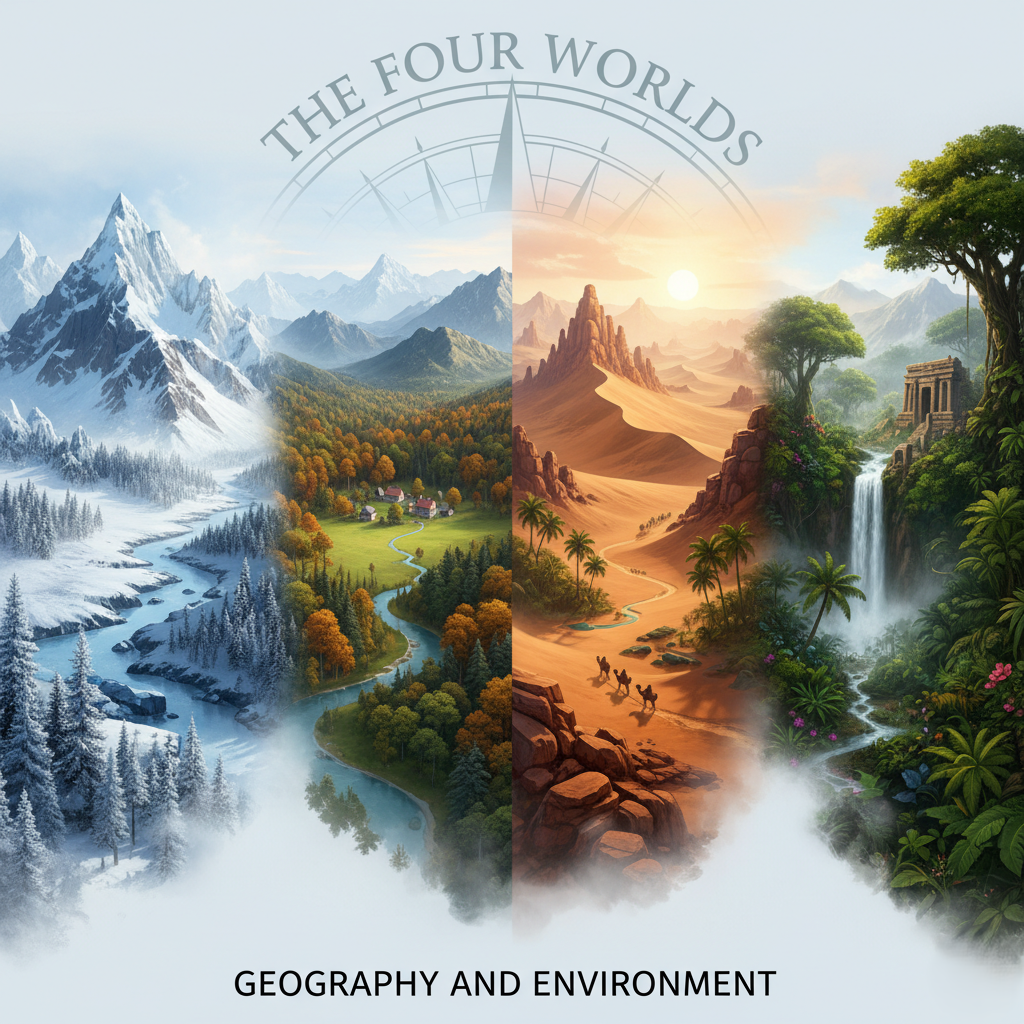
Ecuador’s physical landscape is traditionally divided into four distinct regions, often referred to by Ecuadorians as the “Four Worlds,” each with its own climate, ecology, and unique way of life.
1. La Costa (The Pacific Coastal Lowlands)
The westernmost region, characterized by low-lying plains, fertile agricultural lands, and a warm, tropical climate.
- Key Features: This region is the nation’s economic engine, centered around Guayaquil, the country’s largest city and principal port. Its economy relies heavily on large-scale agricultural exports, particularly the famed Ecuadorian banana (the world’s largest exporter), shrimp, and cocoa.
- Climate: Generally hot and humid, with a rainy season (January to April) and a drier season.
2. La Sierra (The Andean Highlands)
Running down the center of the country, the Andes Mountains split into two major parallel chains—the Cordillera Occidental and the Cordillera Oriental—separated by high valleys known as hoyas.
- Key Features: This is the realm of majestic volcanoes, many of which are snow-capped and active, including Chimborazo (the highest peak, whose summit is the farthest point from the Earth’s center) and Cotopaxi (one of the world’s highest active volcanoes). The capital, Quito, a UNESCO World Heritage Site, sits nestled in an Andean valley at an elevation of 9,350 feet. The region is home to the Serranos—the mountain people—many of whom are of indigenous Kichwa descent, maintaining strong traditions.
- Climate: Temperate to cold, often referred to as “eternal spring” in the valleys, but reaching sub-zero temperatures at the higher elevations.
3. El Oriente (The Amazon Rainforest)
The eastern lowlands, occupying approximately half of Ecuador’s landmass, are part of the vast Amazon River Basin.
- Key Features: Characterized by dense, humid tropical rainforests and a network of rivers flowing toward the Amazon. This region is a global hotspot for biodiversity, containing countless species of flora and fauna. Crucially, El Oriente is also the location of Ecuador’s significant petroleum reserves, making it vital to the national economy but creating persistent conflicts between resource extraction and environmental/indigenous rights. It is home to various indigenous groups, including the Waorani and Shuar.
- Climate: Hot, very humid, and rainy year-round.
4. Las Islas Galápagos (The Galápagos Islands)
Located approximately 600 miles (1,000 km) off the mainland coast, this volcanic archipelago is a world unto itself.
- Key Features: Famous for its unique endemic species—such as the Giant Tortoise, Marine Iguanas, and Blue-footed Boobies—the islands provided the key inspiration for Charles Darwin’s theory of natural selection. The entire archipelago is a protected national park and a UNESCO World Heritage Site, serving as a pillar of Ecuador’s global identity and a major source of eco-tourism revenue.
📜 Chapter II: History, Identity, and Culture
Ecuador’s rich and complex cultural identity is a direct result of its turbulent history, which spans powerful pre-Incan civilizations, imperial conquest, and the establishment of a modern republic.
Pre-Columbian and Inca Eras
Before the Spanish arrival, the territory was home to numerous sophisticated indigenous groups, such as the Valdivia (one of the oldest known cultures in the Americas), the Cañari, and the Quitu. In the 15th century, the region was integrated into the rapidly expanding Inca Empire (known as Tawantinsuyu). The city of Quito became a critical northern administrative center, and the Kichwa language became the lingua franca throughout the highlands. The Incan influence, though relatively brief, profoundly shaped the spiritual and social structures of the Andean communities.
The Spanish Colonial Period
The arrival of the Spanish conquistadors, led by Francisco Pizarro in the 1530s, coincided with a brutal Inca civil war, facilitating the Spanish conquest. The territory became the Royal Audiencia of Quito within the Viceroyalty of Peru, and later New Granada. The Spanish established major colonial centers like Quito and Cuenca, focusing on mining and agricultural exploitation using forced indigenous labor. This period cemented Roman Catholicism as the dominant religion and Spanish as the official language, though both were often syncretized with indigenous beliefs.
Independence and Republican Instability
Ecuador gained its independence in 1822 as part of Gran Colombia (along with Venezuela, Colombia, and Panama), under the leadership of Simón Bolívar. However, this union was short-lived, and Ecuador became a fully sovereign state in 1830. The 19th and early 20th centuries were characterized by deep political instability, marked by a pervasive struggle between conservative and liberal factions, and frequent regional tensions between the highland (Sierra) and coastal (Costa) elites.
Cultural Identity and Ethnicity
Ecuador is officially a multi-ethnic and pluricultural nation. The demographic breakdown is generally:
- Mestizo: The largest group, representing a mix of European and Indigenous ancestry.
- Indigenous: Comprising several distinct nations, primarily the Kichwa in the Andes and various groups in the Amazon, who maintain strong linguistic and cultural traditions.
- Montubio: A distinct Mestizo group residing in the coastal lowlands, known for their agricultural and equestrian skills.
- Afro-Ecuadorian: Concentrated mainly in the Esmeraldas province on the Pacific coast and the Chota Valley, their culture is rich in music (such as the marimba) and distinct traditions brought by African slaves.
Family remains the bedrock of Ecuadorian society, often involving multi-generational living. Cultural expressions are vibrant, from the world-renowned weaving traditions of Otavalo to the classical colonial architecture of Quito and the lively coastal rhythms of Salsa and Marimba.
💰 Chapter III: Economy and Modern Challenges
Ecuador’s economy is classified as developing, but it remains highly reliant on a few key commodity exports, a structure that exposes it to global price volatility.
Dollarization and Stability
In the year 2000, facing a severe economic crisis and hyperinflation, Ecuador made the pivotal decision to abandon its national currency, the Sucre, and adopt the U.S. Dollar. This policy of dollarization successfully stabilized inflation and restored market confidence, though it simultaneously relinquished the government’s ability to use monetary policy to manage economic shocks.
Principal Economic Pillars
- Petroleum: Crude oil is historically the single most important export, accounting for a significant percentage of national revenue. Most extraction occurs in the Amazon region (El Oriente), leading to ongoing environmental and social debates.
- Agriculture: Ecuador is a global powerhouse in agricultural exports. It is the world’s largest exporter of bananas and a major global producer of shrimp, cocoa, and coffee. The coastal lowlands are the primary region for these industries.
- Mining: Gold and copper mining have become increasingly significant, attracting foreign investment but also generating intense scrutiny regarding environmental impact, particularly in the Andean foothills.
- Tourism: The Galápagos Islands are an internationally recognized destination that generates substantial revenue. Furthermore, the cultural heritage of cities like Quito and Cuenca, and the vast potential for eco-tourism in the Amazon and Andes, make the sector a crucial growth area.
- Flowers: Ecuador is one of the world’s largest exporters of cut roses, prized globally for their large heads and long stems due to the ideal growing conditions near the Equator.
Social and Political Challenges
Ecuador faces profound challenges that temper its success:
- Political Instability: The country has a history of political volatility and high turnover of governments.
- Inequality and Poverty: Significant disparities exist between the urban centers and rural areas, as well as between the coastal and highland regions. Widespread informal employment remains a major structural issue.
- Security Crisis: In recent years, Ecuador has faced a sharp rise in crime and drug trafficking activity, a crisis that has profoundly impacted national security and public confidence.
- Environmental Strain: The twin pressures of oil drilling in the Amazon and large-scale mining operations create constant tension with indigenous land rights and the nation’s commitment to environmental preservation.
🌟 Conclusion
Ecuador is a microcosm of South America itself—a vibrant, tumultuous, and utterly essential nation defined by its extreme geographical and cultural juxtapositions. From the revolutionary evolutionary science of the Galápagos to the ancient high-altitude markets of the Sierra, it presents a compelling case study in a country struggling to harness its immense natural wealth and cultural diversity for modern development. The story of Ecuador is one of survival, resilience, and a perpetual search for stability that honors the profound historical layers of its indigenous past and its colonial inheritance.