

I. Introduction
- Hook & Thesis Statement: Start with a compelling fact about Amazon’s scale or a famous AI product (like Alexa or the recommendation engine). The thesis should state that Amazon’s Artificial Intelligence (AI) strategy is not merely a feature, but the foundational and pervasive technological infrastructure powering its diverse, multi-billion dollar business lines, from e-commerce and cloud computing to logistics and entertainment, establishing it as a global leader in applied AI.
- Historical Context: Briefly mention Amazon’s long history with AI/Machine Learning (ML), starting with its recommendation system over two decades ago.
- Scope of the Essay: Introduce the main areas the essay will explore:
- The role of AWS as the democratizer of AI technology.
- The transformative power of AI in its e-commerce and logistics operations.
- The impact of consumer-facing AI (Alexa, Rufus).
- The commitment to Responsible AI and future direction.
II. The Foundational Pillar: Amazon Web Services (AWS) and AI
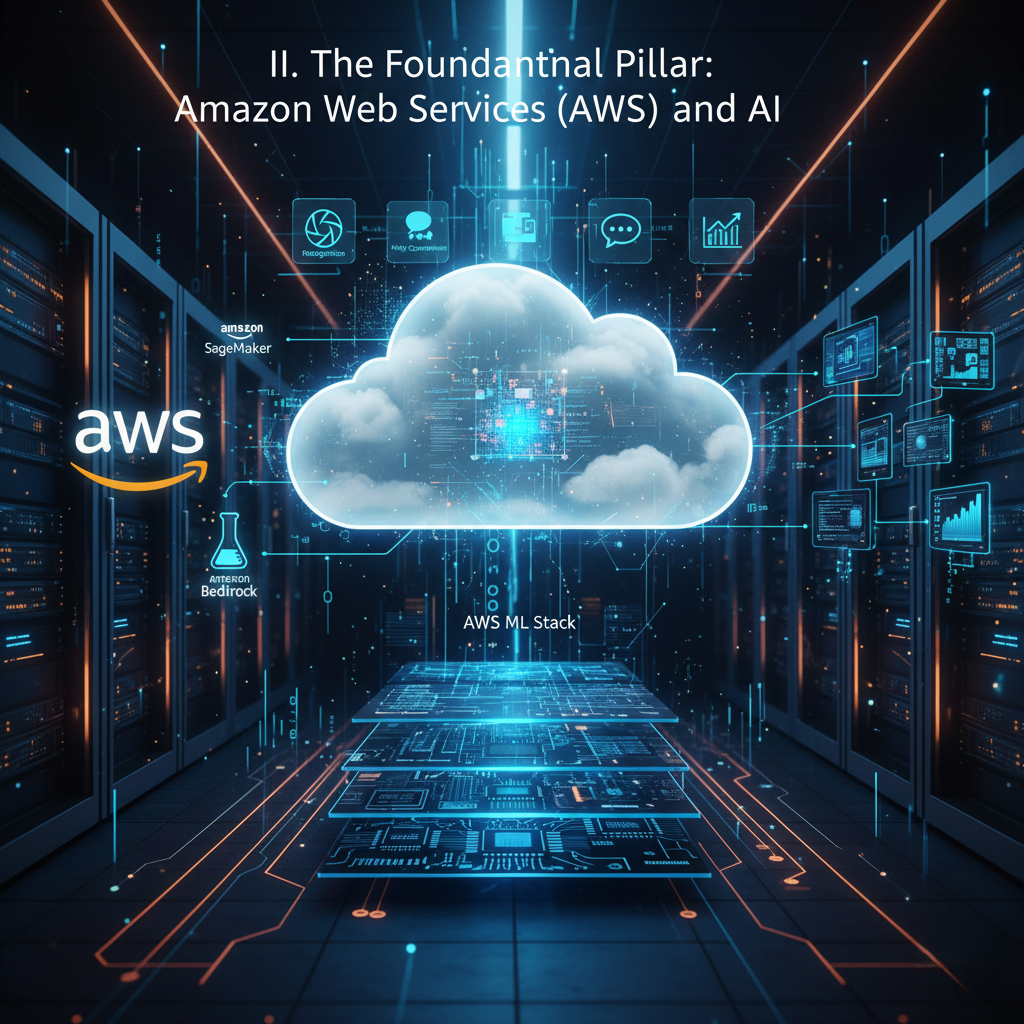
This section must emphasize that AWS is the engine that not only runs Amazon’s AI but also provides AI to the rest of the world.
A. Democratizing AI: The AWS ML Stack
- The Three-Layer Approach: Detail the three core layers of AWS’s AI offering.
- Bottom Layer (Infrastructure): Mention specialized hardware for training and inference, such as AWS Trainium and Inferentia chips. Discuss the significance of massive-scale compute clusters like Project Rainier.
- Middle Layer (ML Services): Focus on Amazon SageMaker. Describe it as the end-to-end platform for building, training, and deploying ML models at scale. Highlight its features like Studio, Clarify (for explainability), and HyperPod (for distributed training).
- Top Layer (AI Services): Discuss ready-to-use, pre-trained AI services.
- Vision: Amazon Rekognition (image/video analysis).
- Language: Amazon Comprehend (text analysis, NLP) and Amazon Polly (Text-to-Speech).
- Forecasting: Amazon Forecast (time-series predictions).
B. The Generative AI Revolution: Amazon Bedrock
- The Central Hub: Explain Amazon Bedrock as the fully managed service for building generative AI applications.
- Model Diversity: Emphasize its openness to various Foundation Models (FMs), including Amazon’s own Titan family, as well as models from partners like Anthropic (Claude), Meta (Llama), and Mistral AI. This highlights Amazon’s model-agnostic approach.
- Enterprise Focus: Discuss how Bedrock addresses enterprise needs through features like Guardrails (for responsible deployment), customization, and seamless integration with corporate data.
III. AI in the Core Business: E-commerce and Logistics Transformation
This section focuses on how AI optimizes Amazon’s retail and supply chain operations, which are arguably its most complex business areas.
A. Hyper-Personalization in Retail
- Recommendation Engines: Go beyond simple “customers who bought this also bought…” Explain the complex deep learning models behind personalized product recommendations, personalized search results, and dynamic pricing strategies. Mention Amazon Personalize as the AWS service used for this.
- The Shopping Assistant: Detail the function and impact of Rufus, the new generative AI-powered shopping assistant. Include the reported financial projection of a multi-billion dollar impact as a key metric of success.
- Content Creation: Discuss AI-powered tools for sellers, such as generative AI for writing product listings, summarizing customer reviews, and creating marketing copy.
B. Supply Chain and Operational Efficiency
- Forecasting and Inventory Management: Explain how ML models analyze vast amounts of data (seasonal trends, promotions, news events) to predict demand for hundreds of millions of products, reducing waste and stockouts.
- Warehouse Robotics and Automation: Discuss the role of AI in coordinating the fleet of autonomous robots (e.g., Kiva systems) within fulfillment centers. Detail how computer vision and machine learning optimize picking, packing, and sorting processes.
- Last-Mile Delivery Optimization: Explain the sophisticated routing algorithms that use real-time data (traffic, weather, delivery windows) to determine the most efficient delivery routes, including the use of autonomous systems like Prime Air drones.
IV. The Consumer-Facing AI Experience
This section covers the direct, visible impact of Amazon’s AI on the daily lives of consumers.
A. Alexa and the Intelligent Home
- Evolution of Voice AI: Discuss Alexa’s foundation in Natural Language Processing (NLP) and Automatic Speech Recognition (ASR). Explain the continuous learning loops (data collection, model retraining) that allow Alexa to understand billions of weekly interactions.
- The Next Generation (Alexa+): Detail the move towards a more proactive, conversational, and personalized assistant, powered by advanced generative AI models, which aims to handle more complex, multi-step requests.
- Multimodal Experience: Briefly mention how AI powers Amazon’s other devices like Echo Show (computer vision for Glanceable Content) and Fire TV (personalized content discovery).
B. AI in Media and Entertainment
- Prime Video: Discuss the use of ML for content recommendations, personalized thumbnails, and optimizing video quality streaming based on network conditions.
- Amazon Music: How AI curates personalized playlists and discovers new music based on listener behavior.
V. Challenges, Responsible AI, and Future Outlook
A. Ethical and Societal Challenges
- Responsible AI: Detail Amazon’s commitment, including its Leadership Principles, and the specific tools and practices it has implemented, such as Amazon SageMaker Clarify and Guardrails for Amazon Bedrock, to address bias, fairness, and transparency in models.
- Workforce Impact: Address the complex issue of AI-driven corporate restructuring and layoffs. Discuss CEO Andy Jassy’s statements on AI driving efficiency, which may lead to a reduction in certain corporate roles while simultaneously creating new, high-skilled AI-focused jobs.
- Data Privacy and Security: Discuss the scale of customer data Amazon handles and the AI/ML-driven systems (e.g., fraud detection) in place to secure it, as well as the inherent concerns that come with such massive data-handling capabilities.
B. Future Trajectories
- Continued Investment: Stress Amazon’s massive capital expenditure in AI infrastructure (data centers, chips) as a clear indicator of its long-term commitment.
- Agentic AI: Discuss the future of autonomous AI agents that can complete multi-step, complex tasks across different applications, which is the current frontier for generative AI.
- The ‘AI-Driven Enterprise’: Conclude by reiterating that Amazon is fundamentally transitioning into a fully AI-driven enterprise, where the technology is the main competitive differentiator across all its ventures.

